

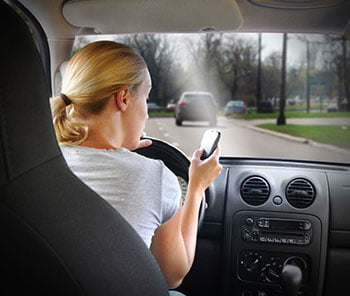
April is national distracted driving awareness month. As such, we all have a duty to promote awareness about the serious danger distracted driving poses to drivers, passengers and pedestrians alike.
When you mention distracted driving, often, the first thing that comes to mind is a driver talking or texting while driving on a busy roadway. In Kansas, the law bans texting for all drivers and any cell phone use (handheld and hands free) for novice drivers (drivers with a learner’s permit or intermediate license).
While using a cell phone may be one of the most common forms of distracted driving, there are many other activities that take focus away from our primary task of safe driving.
The U.S. Department of Transportation defines distracted driving as:
“Any activity that could divert a person’s attention away from the primary task of driving. All distractions endanger driver, passenger, and bystander safety.”
The National Highway Traffic and Safety Administration (NHTSA) described distraction as:
“Distraction is a specific type of inattention that occurs when drivers divert their attention from the driving task to focus on some other activity.”
Types of distractions include, but are not limited to:
- Texting
- Talking on a cell phone (even hands free)
- Eating and drinking
- Talking to passengers
- Daydreaming
- Reading, including maps
- Using a navigation system
- Adjusting a radio or climate control system
If you aren’t convinced that distracted driving is a major problem, maybe these powerfully persuasive facts and statistics from the NHTSA and Distraction.gov will change your mind.
- Texting and driving is widely considered the most dangerous distractions because the task requires visual, manual and cognitive attention to perform.
- Ten percent of fatal crashes in 2011 were reported as distraction-affected crashes.
- In 2011, 3,331 people were killed in crashes involving distracted drivers and an estimated additional 387,000 were injured in motor vehicle crashes involving distracted drivers.
- In 2011, 495 non-occupants were killed in distraction-affected crashes.
- Drivers in their 20s make up 27% of the distracted drivers in fatal crashes.
- Hands free cell phone use is not substantially safer than hand-held use.
It’s clear that distracted driving is a growing trend, especially among young drivers, and needlessly puts many lives in danger. If you’ve been injured by a distracted driver contact the personal injury attorneys at DeVaughn James Injury Lawyers in Wichita, Kansas. Call 316-888-8888 in Wichita, 785-888-8888 in Topeka or 816-999-9999 in Kansas City for a free case evaluation with no obligation.